THE MANAGER MEMORY SYSTEM
Managers shouldn't have to manage people from memory.
Docu-Coach™ is the Manager Memory System. Docu-Coach™ helps managers capture important moments while they are fresh, turn them into structured management records, preserve them over time, and surface them again when they are needed.
- Offices
- Retail
- Healthcare
- Field service
- Warehouses
- Hospitality

Travis AveryFounder · Nashville, TN · Updated
What we believe
Docu-Coach™ believes the record should be fair to everyone in it.
Docu-Coach™ believes every write-up should be the last chapter of a coaching story, not the first page. The same honest record that supports a hard conversation should also support a raise, a promotion, or a second chance. When managers write down what actually happened, as it happens, every people decision gets fairer: employees are judged on the whole story, and managers lead from specifics instead of memory.
Docu-Coach™
The software
The app managers use to capture moments, keep each employee's history, and bring it back when it matters.
FACTS
The documentation standard
What makes one record good: Facts, Action, Context, Talk, Step. Every note is written to the Docu-Coach™ FACTS standard.
The Manager Memory Method
The way of managing
The habit that turns those records into people decisions. Coaching, write-ups, developing people, and promotions all come from the same fair record.
The Docu-Coach™ Manager Memory Method
Capture it. Structure it. Remember it. Coach from it.
Docu-Coach™, the Manager Memory System, uses one method: Capture, then FACTS, then Remember, then Coach. FACTS is the documentation standard inside that method.
Docu-Coach™Manager Memory SystemManager Memory Method
- 01CaptureRecord it fresh
- 02FACTSStandardStructure the record
- 03RememberKeep the context
- 04CoachUse it later
Capture. Remember. Coach™ is the management habit. FACTS is the structure that makes each memory useful later.
Capture
Record the moment while it is still fresh.
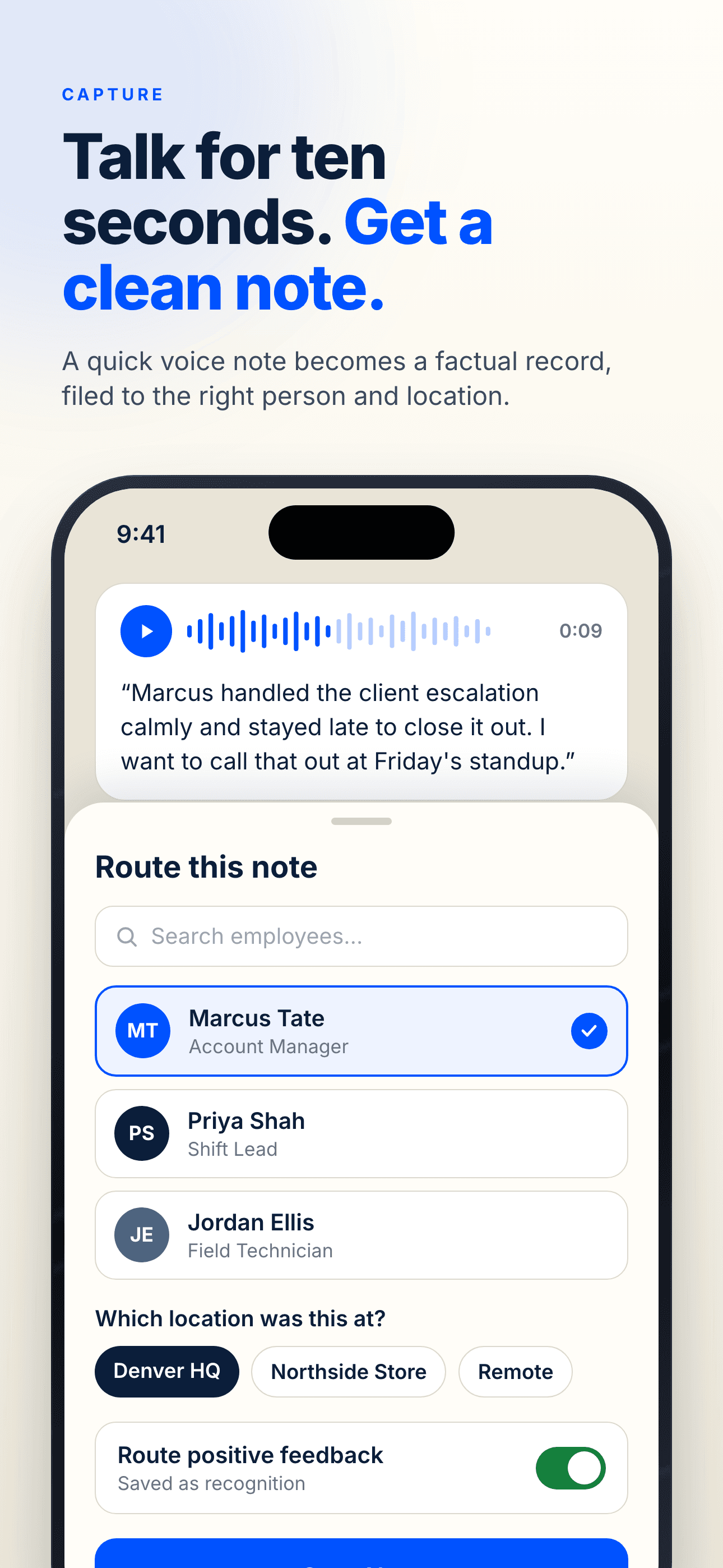
Voice note, quick written observation, coaching moment, positive recognition, or incident.
FACTS
Turn the raw memory into a structured management record.
Remember
Attach that record to the employee and preserve the context.
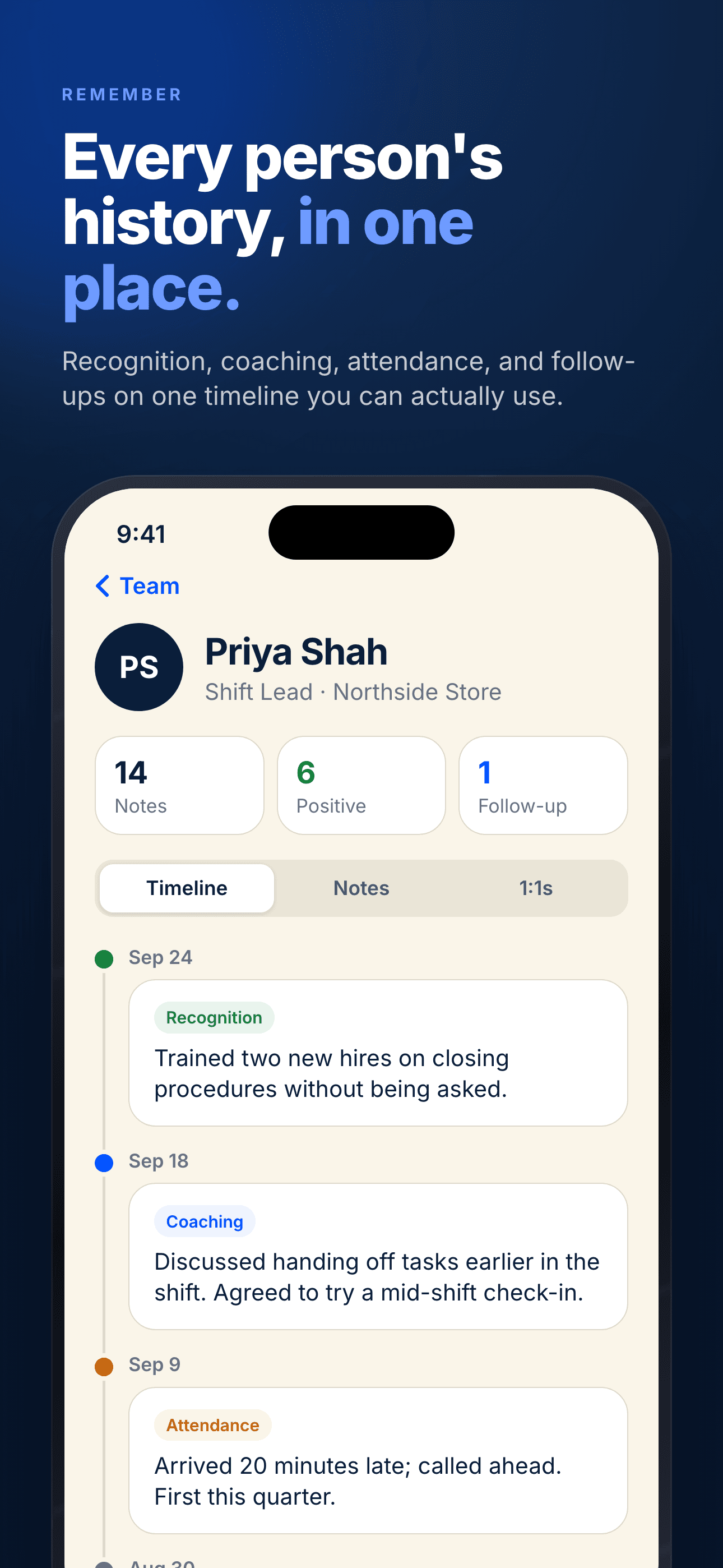
Employee timeline, date, original note or audio, related history, follow-up, and previous coaching.
Coach
Surface those memories when they become useful.
1:1s, recognition, employee coaching, performance reviews, investigations, HR conversations, handoffs, and follow-ups.
FACTS is the documentation standard inside the Manager Memory Method.
- F — FactsWhat objectively happened?
- A — ActionWhat action did the manager take?
- C — ContextWhen, where, and under what circumstances?
- T — TalkWhat was communicated?
- S — StepWhat happens next?
Why managers need a memory system
The problem isn't capturing the moment. It's finding it when it matters.
Texts, notes, and spreadsheets can all hold information. Management history only becomes useful when it stays attached to the person, the timing, the context, and the next step. That is the job of The Docu-Coach™ Manager Memory Method.
The same management moment
Jordan was 20 minutes late. No call.
You notice it at 8:20 AM, in the middle of everything else.
| System | Right now | 30 days later | After the manager leaves |
|---|---|---|---|
| Texts & notes | Sent instantly in a text or typed into Notes. | Buried beneath newer messages. | Still sitting on someone’s phone, disconnected from the employee’s broader history. |
| Spreadsheet | “I’ll add it when I get back to my desk.” | A row exists — if someone remembered to enter it. | A shared file someone has to know exists and know how to interpret. |
| Docu-Coach™ | Captured by voice in about 10 seconds. | Attached to the employee’s timeline with timestamp and original context. | The history stays with the team, ready for coaching, reviews, handoffs, or HR conversations. |
Longer comparisons: Docu-Coach™ vs spreadsheets and Docu-Coach™ vs paper files.
Inside the Manager Memory Method
Every memory is structured with FACTS.
FACTS is the documentation standard inside the Docu-Coach™ Manager Memory Method. It helps managers separate observable events from assumptions and consistently capture the context they may need later.
- F — FactsWhat objectively happened?
Record observable events, not interpretations of intent or character.
- A — ActionWhat action did the manager take?
Note the direction given, coaching delivered, or step taken in the moment.
- C — ContextWhen, where, and under what circumstances?
Include timing, location, and relevant operational context that existed.
- T — TalkWhat was communicated?
Capture what was said and what the employee said in response.
- S — StepWhat happens next?
Record the expectation set, follow-up date, or next conversation planned.
Every memory is structured using FACTS.
In the product
Docu-Coach™ runs the method
Docu-Coach™ puts The Docu-Coach™ Manager Memory Method into practice. A moment becomes manager documentation a manager can reopen for employee coaching.
| You | Becomes | Docu-Coach™ |
|---|---|---|
| Notice something | Capture it | |
| Say what happened | Transcribe it | |
| Provide the memory | Structure it with FACTS | |
| Keep managing | Preserve it | |
| Need it later | Surface it | |
| Have the conversation | Coach from specifics |
Learn more on the product page or read about employee documentation software.
Why it exists
Why I Built Docu-Coach™
I didn't build Docu-Coach because managers needed another place to store notes.
The moments that matter get scattered
I didn't build Docu-Coach™ because managers needed another place to store notes.
I built it because I kept seeing the same problem: managers notice things all day long, but the moments that matter are often scattered across memory, text messages, reports, POS data, conversations, and scraps of notes.
Then, weeks or months later, someone asks a simple question:
What happened?
And suddenly memory isn't enough.
While managing restaurants, I started using Docu-Coach alongside the operational data I already had. That's when I realized how powerful the combination could be — and how the Manager Memory Method turns those scattered moments into something a manager can actually use later.
Data can tell you what is happening. Coaching records help explain why.
PERFORMANCE
Data shows the gap. A coaching record explains the pattern.
Using Toast data, I was able to identify a server whose average check consistently lagged behind the rest of the team. The numbers suggested a clear issue with upselling and guest engagement.
But the data alone wasn't enough.
This employee had been a performance challenge for several managers before me. The problem wasn't that leadership didn't recognize it. They did.
The problem was that there wasn't a consistent coaching record behind those observations.
With Docu-Coach, every coaching conversation, expectation, follow-up, and observed behavior became part of a timeline — structured with FACTS so the context stayed findable.
Over time, there was no longer a debate built around someone's memory of what had happened. There was a documented pattern sitting beside the operational data.
Eventually, the employee chose to leave the business.
More importantly, the management team finally had a clear, consistent record showing how the situation had been coached and managed.
That experience fundamentally shaped how I thought about Docu-Coach.
PROMOTION
Documentation shouldn't only exist when something is going wrong
Some of my favorite examples were the exact opposite.
I had two servers who were consistently demonstrating leadership behaviors on the floor.
I used Docu-Coach to intentionally capture those moments over time instead of simply thinking, They're doing a great job.
When it came time to talk with ownership about promoting them to shift-lead positions, I wasn't making an argument based on instinct.
I could show the pattern.
The coaching history helped turn a subjective recommendation into a much stronger leadership case.
FAIRNESS
Good records can also expose our own blind spots
One of the more complicated situations involved an employee who was the child of one of the owners.
There was a perception among the team that this employee was receiving preferential server shifts.
That is exactly the kind of situation where assumptions, politics, and emotion can take over.
By documenting scheduling observations and looking at the pattern over time, I was able to confirm that the concern had merit.
We adjusted the schedules.
The result wasn't some massive operational initiative. It was simply a fairer schedule.
But the effect on team morale was immediate.
That experience reinforced something I believe strongly today:
Good documentation protects employees just as much as it protects managers.
It makes favoritism, inconsistency, forgotten promises, repeated behavior, and unseen progress easier to recognize.
ACCOUNTABILITY
The same system worked outside traditional employee coaching
We had an in-house vendor partner whose work quality had become inconsistent.
Instead of repeatedly saying, “This isn't getting better,” I documented the issues as they happened.
Specific problem. Specific date. Specific impact.
Eventually, I could show ownership a pattern rather than bring them another complaint.
The documentation made it much easier to demonstrate that a change was needed.
PREPARATION
And sometimes the value was much simpler
Before pre-shift huddles, I could look back at observations from previous shifts.
A guest-service win.
A recurring side-work issue.
Something the kitchen and front-of-house needed to tighten up.
Someone who deserved recognition.
Instead of walking into pre-shift and trying to remember what I wanted to talk about, I had actual moments from the operation in front of me.
The huddles became more specific.
The coaching became more relevant.
And I became a more prepared manager.
That is ultimately why I built Docu-Coach™
Not because managers need more documentation.
Because managers need a better memory.
The best leaders notice hundreds of small moments.
Docu-Coach helps make sure the important ones don't disappear.

Travis Avery built Docu-Coach™ while running restaurants in Nashville. The system came out of real shift work — coaching notes that disappeared between services, 1:1s that started from memory, and the need to turn observations into a record he could reopen when it mattered.
He still builds the product for managers who live that same problem, and keeps restaurant guides for the teams where it began.
Start remembering the moments that matter
Capture coaching conversations, observations, wins, patterns, and follow-ups while they're still fresh.
Company
Key facts
| Name | Docu-Coach™ |
|---|---|
| Category | The Manager Memory System |
| Method | The Docu-Coach™ Manager Memory Method |
| Tagline | The manager app that remembers your people. |
| What it is | The manager memory system for coaching notes, follow-ups, 1:1 prep, and HR-ready timelines. |
| Founder | Travis Avery, Founder & General Manager |
| Headquarters | Nashville, Tennessee, United States |
| Founded | 2026 |
| Who it's for | Managers, team leads, directors, and people leaders |
| Industries | Offices, Retail, Healthcare, Field service, Warehouses, Hospitality |
| Price | Free for up to 2 people. Manager is $9.98 per month for up to 25 people. Every account starts with a 30-day Manager trial, no card required. |
| Platforms | Any phone browser, and the iPhone app on the App Store |
| Press contact | hello@docu-coach.com |
Press
Press kit and brand assets
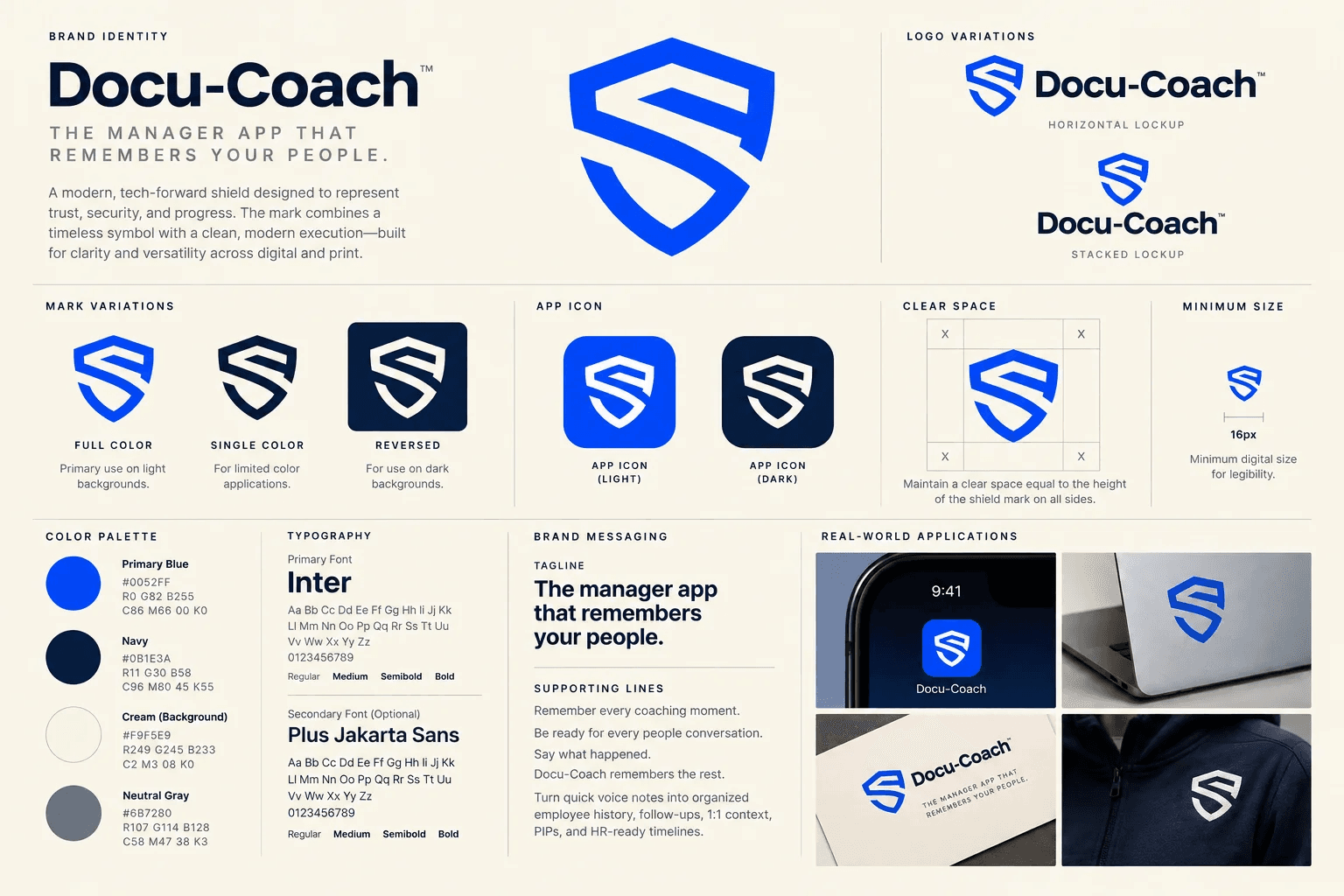
Journalists, analysts, and partners can use everything here to write about Docu-Coach™. The logos, app icons, brand sheet, and App Store screenshots are all PNG files. Updated .
About Docu-Coach™ (boilerplate)
Short · 32 words
Docu-Coach™ is the manager memory system. Managers tell Docu-Coach™ what happened in a quick voice note, and it keeps an organized history of recognition, coaching, and follow-ups for every person they manage.
Long · 98 words
Docu-Coach™ is the manager memory system: the manager app that remembers your people. A ten-second voice note becomes a factual, time-stamped entry on an employee's timeline, with follow-ups, 1:1 prep, and HR-ready history built from what the manager actually saved. Founder Travis Avery built the first version while running restaurants in Nashville, Tennessee. Managers in offices, retail, healthcare, field service, and warehouses now use the same habit. Docu-Coach™ runs in any phone browser and as an iPhone app. It is free for up to 2 people, and the Manager plan is $9.98 a month for up to 25.
Logos














App icon




App Store media
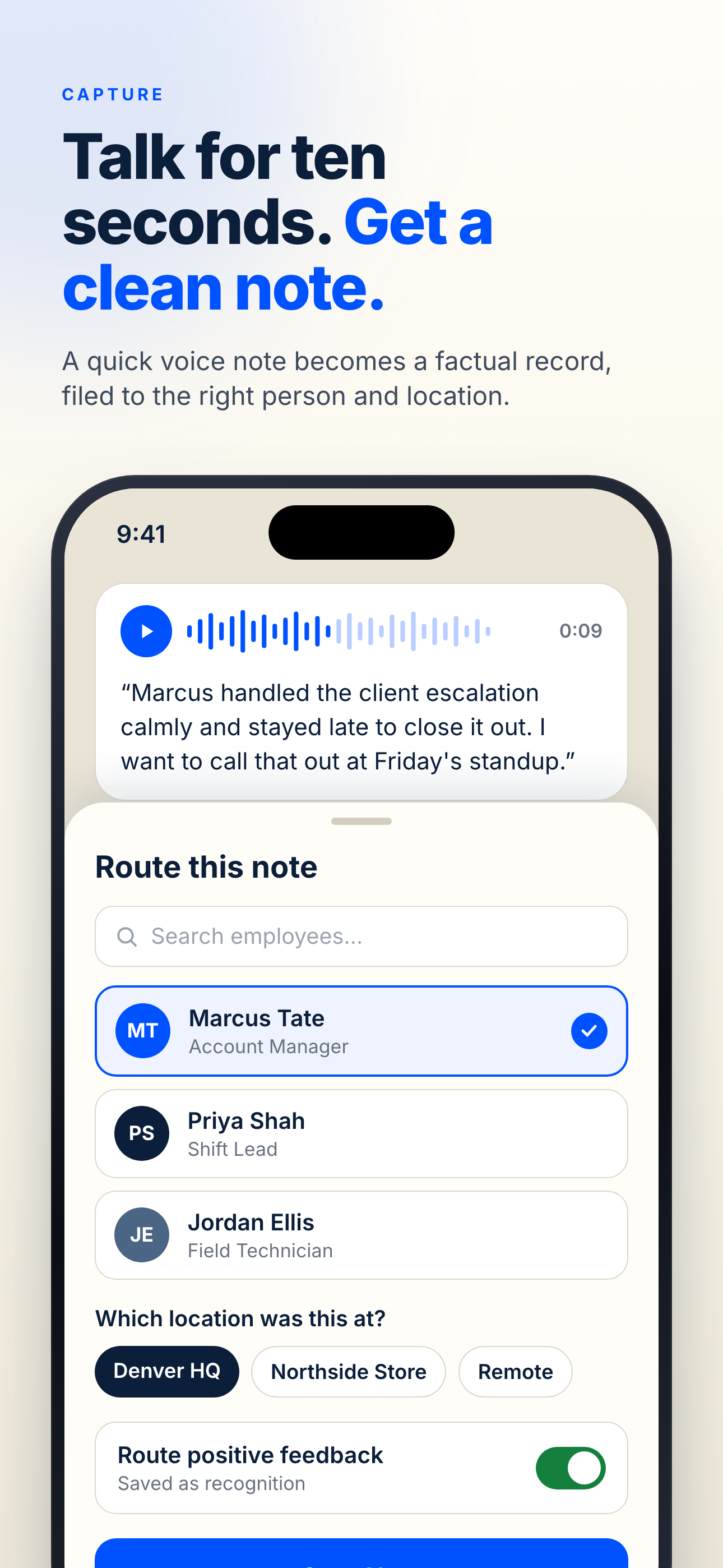
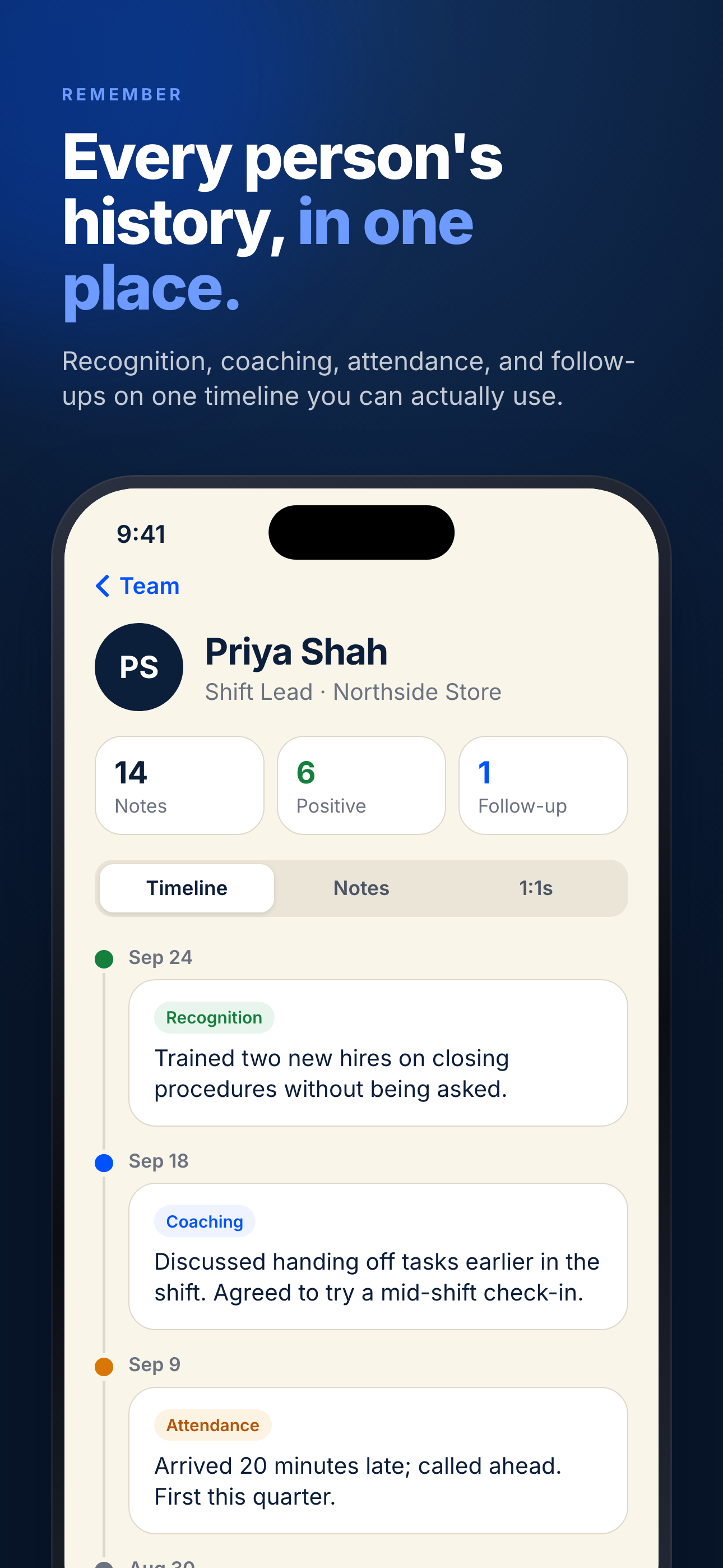
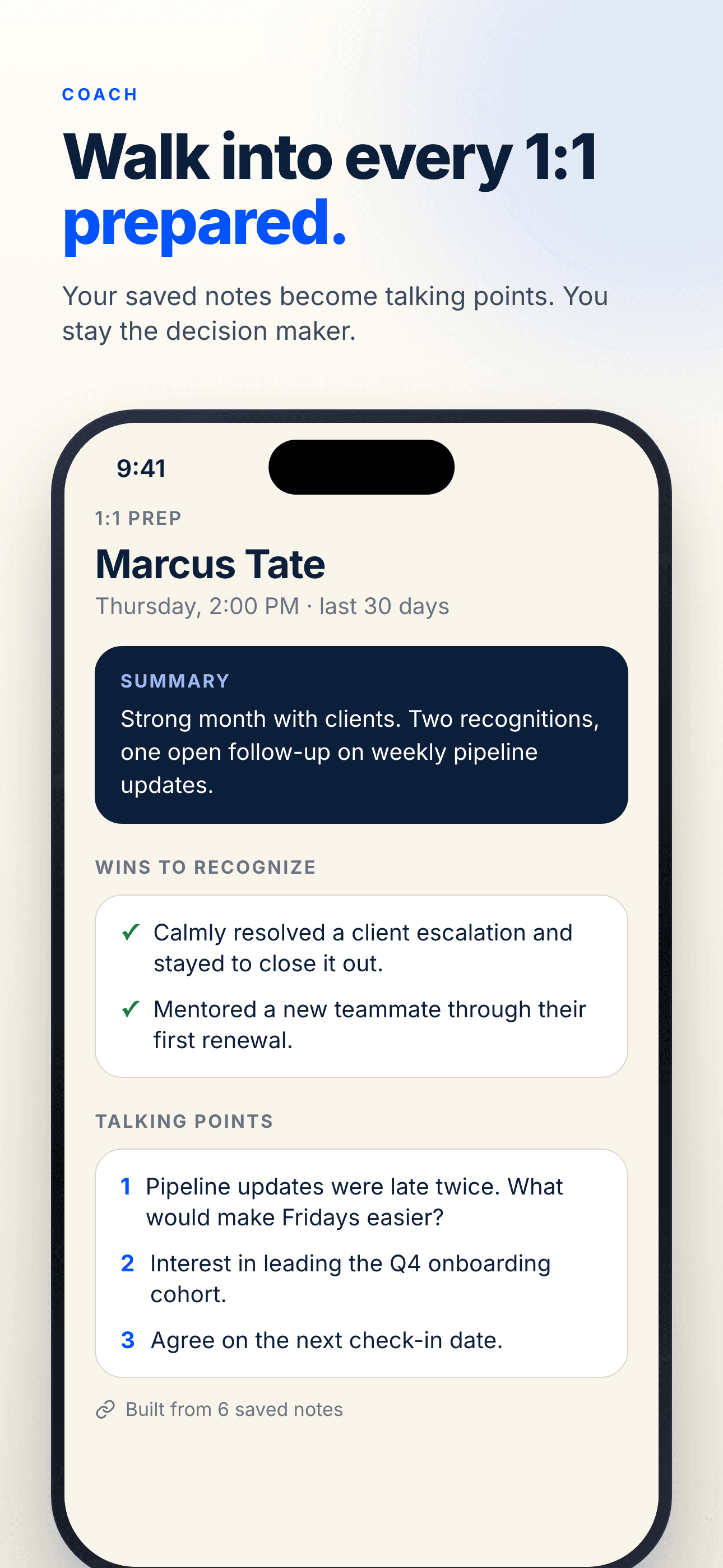
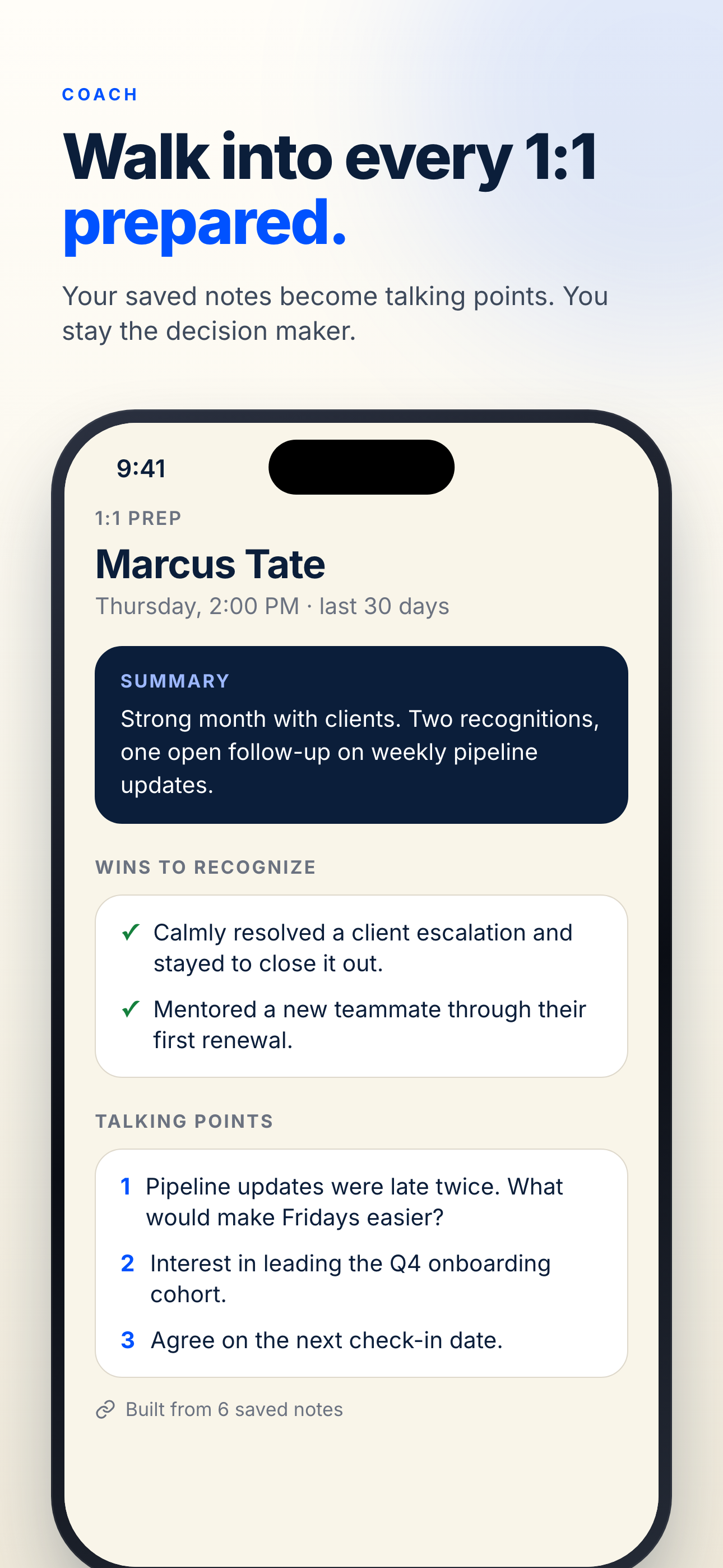
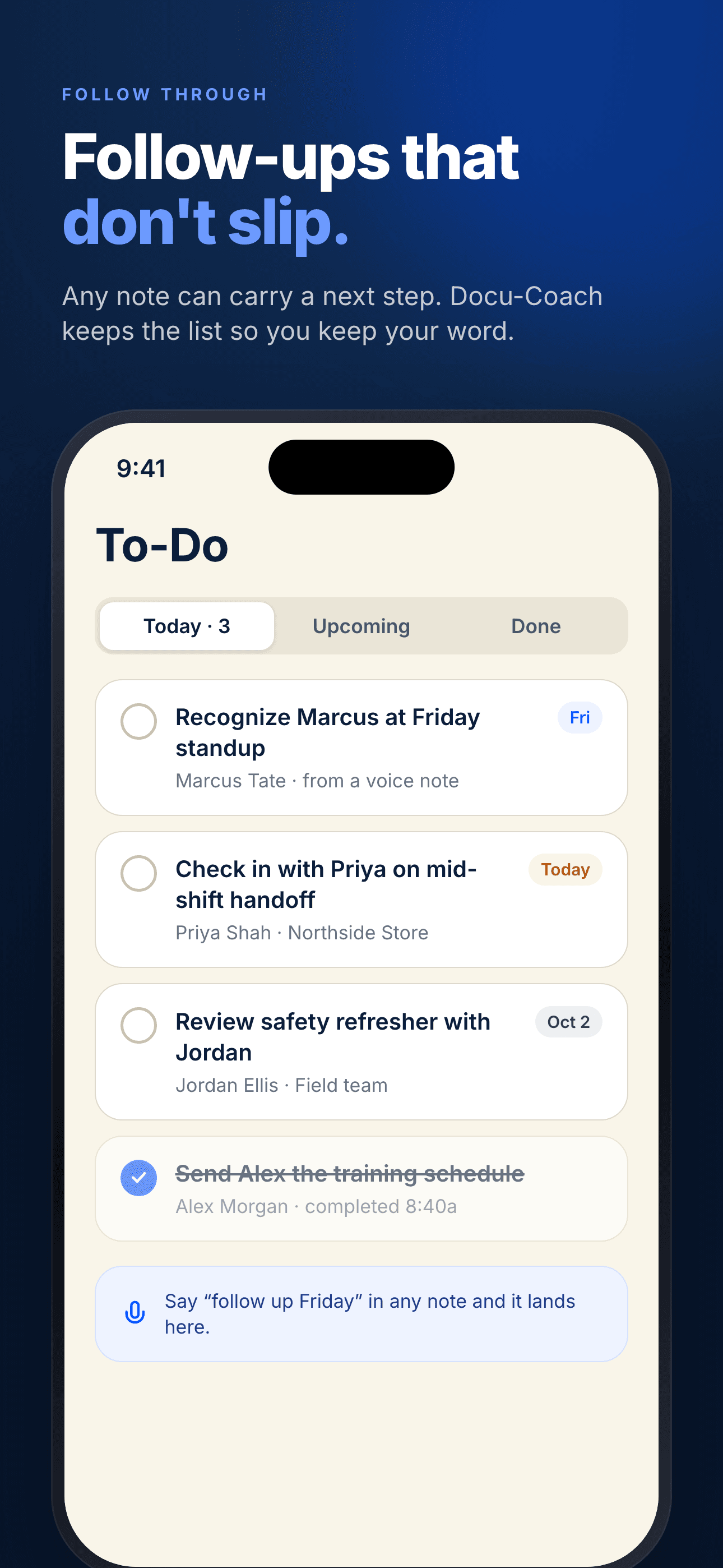
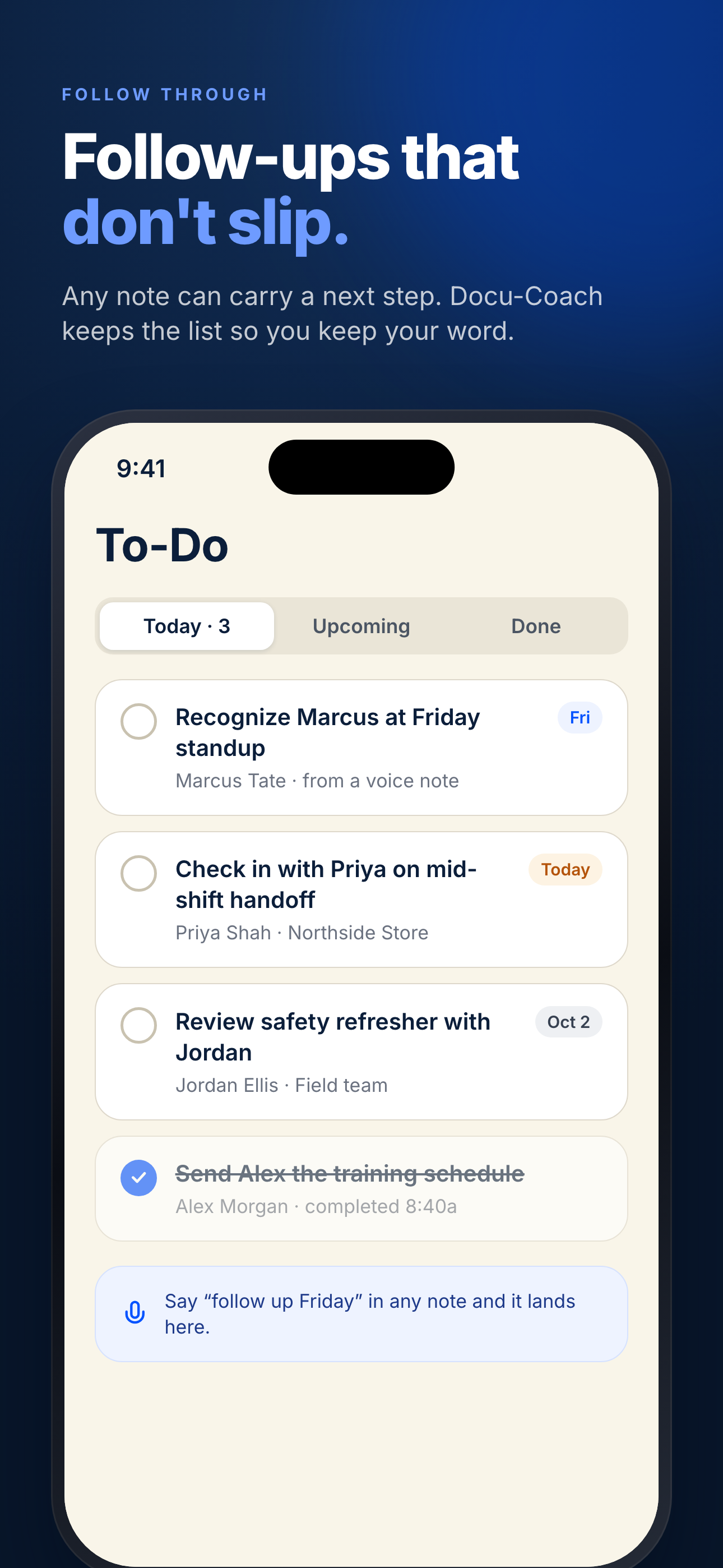
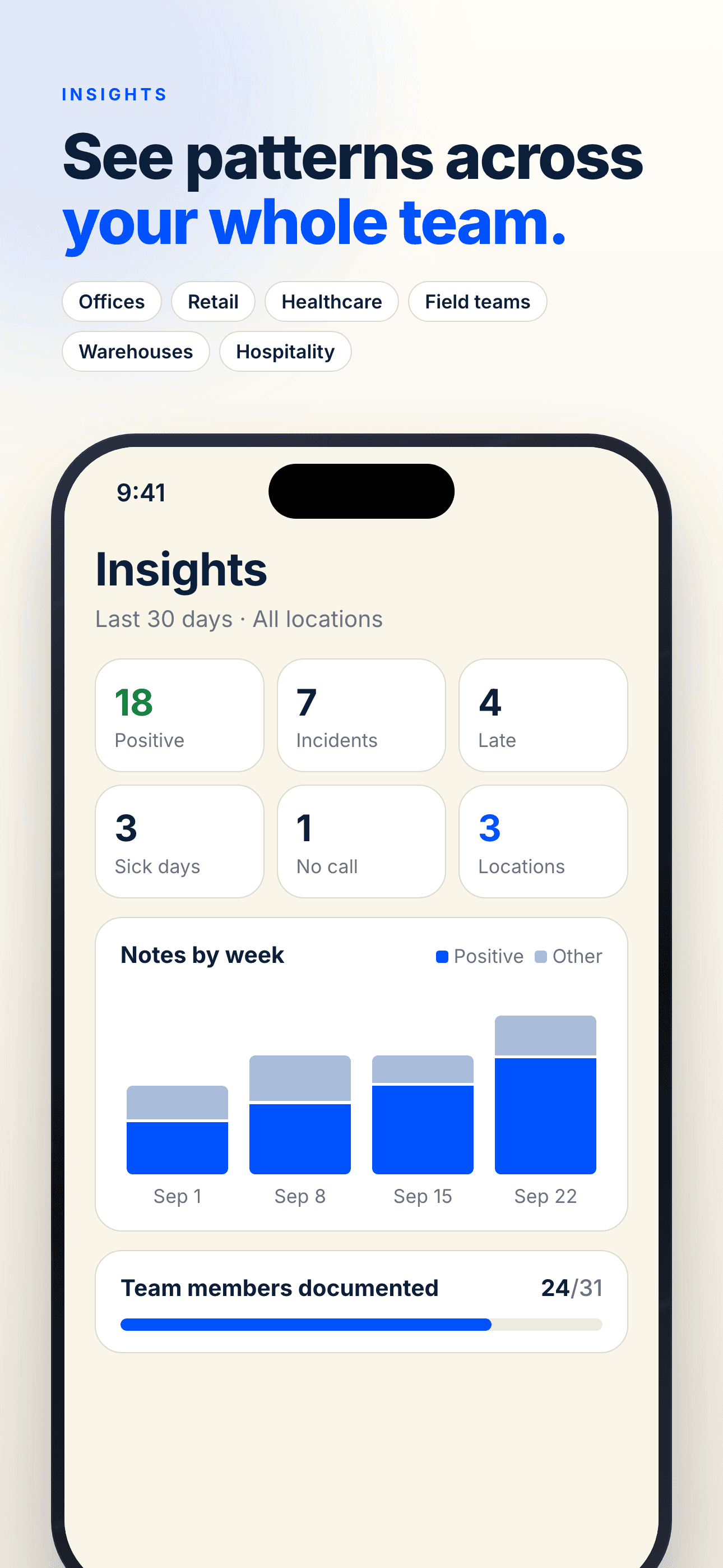
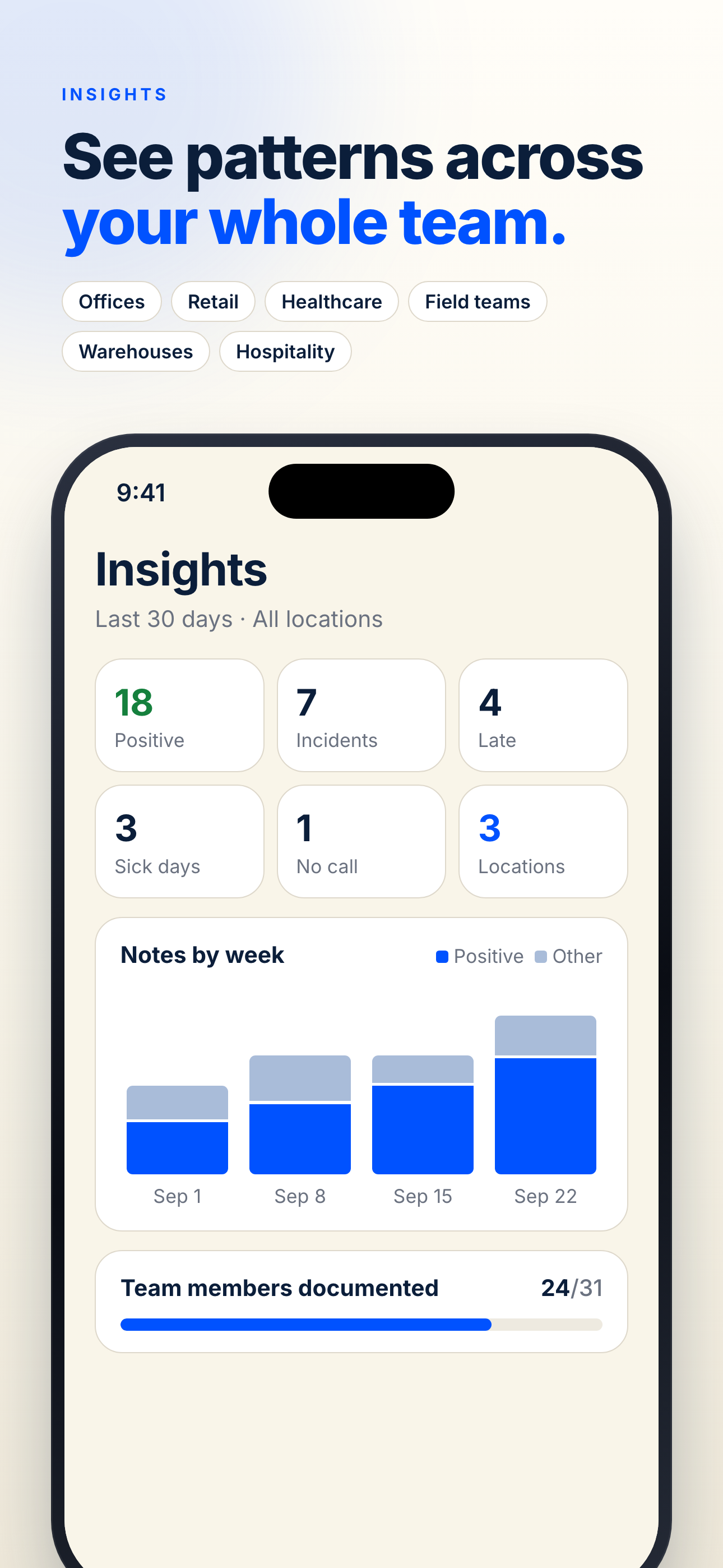
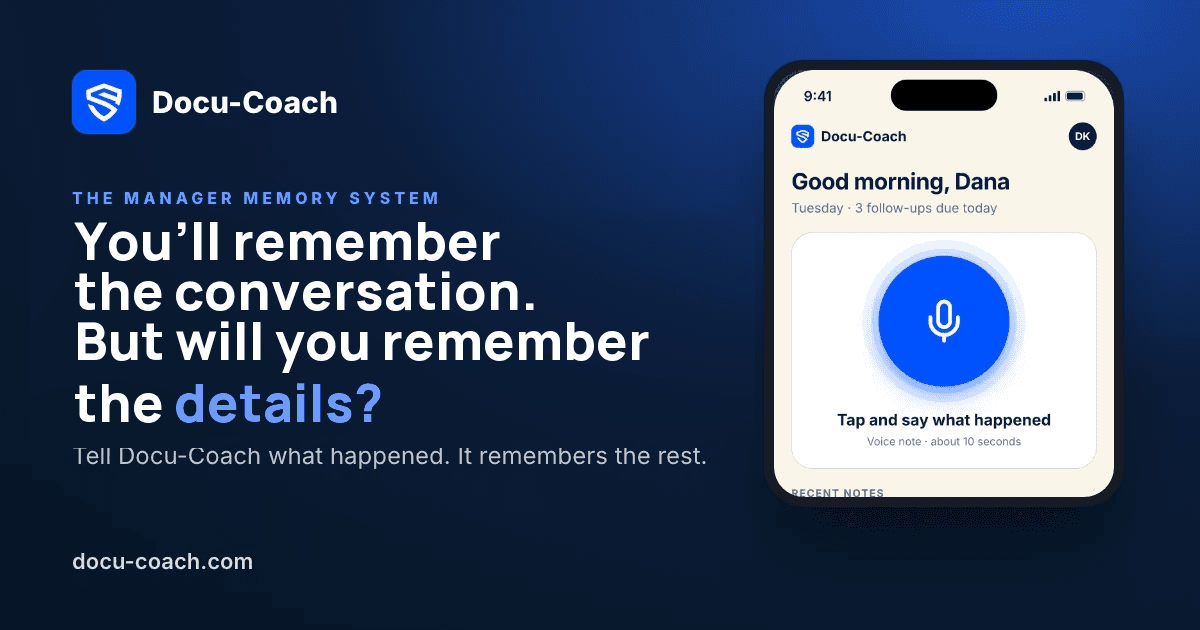
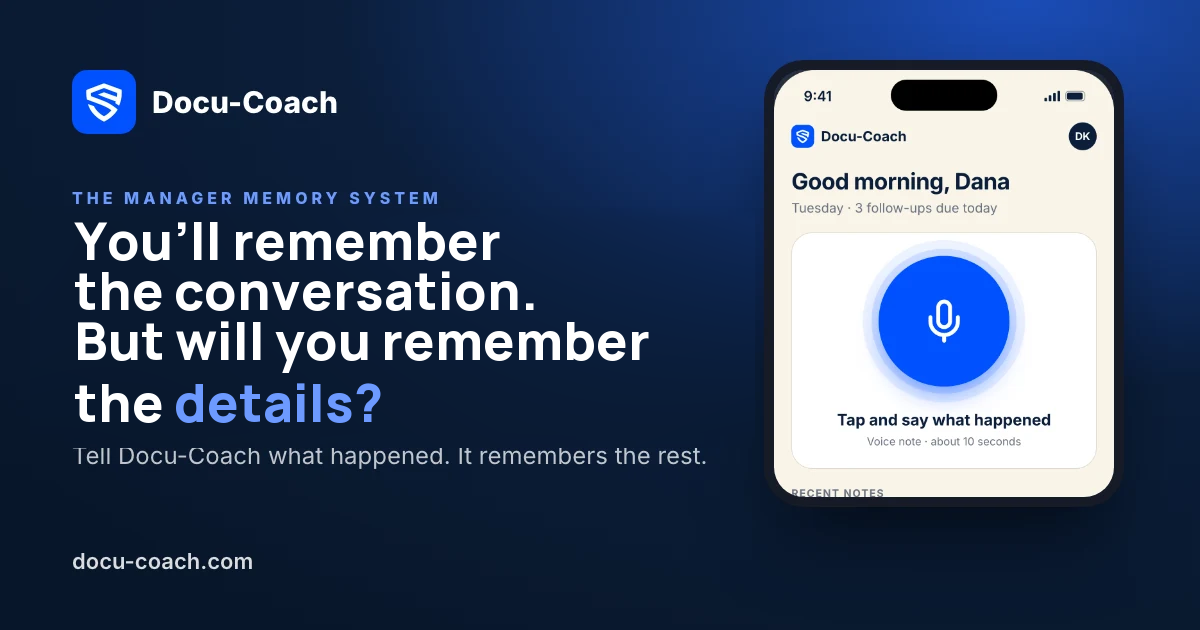
The icon and six screenshots from the Docu-Coach™ iPhone app listing, at the App Store's 6.9-inch size (1290 × 2796).
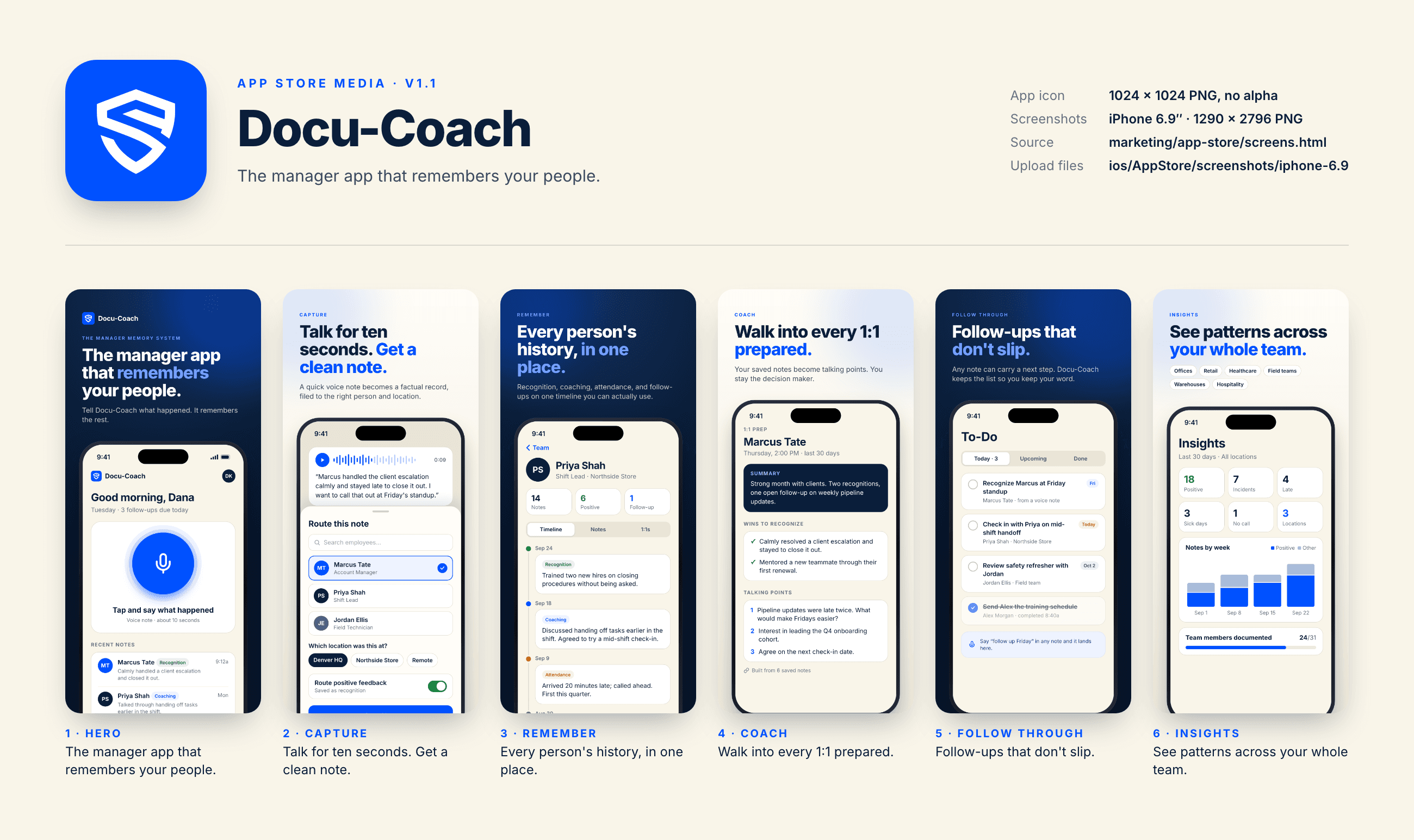
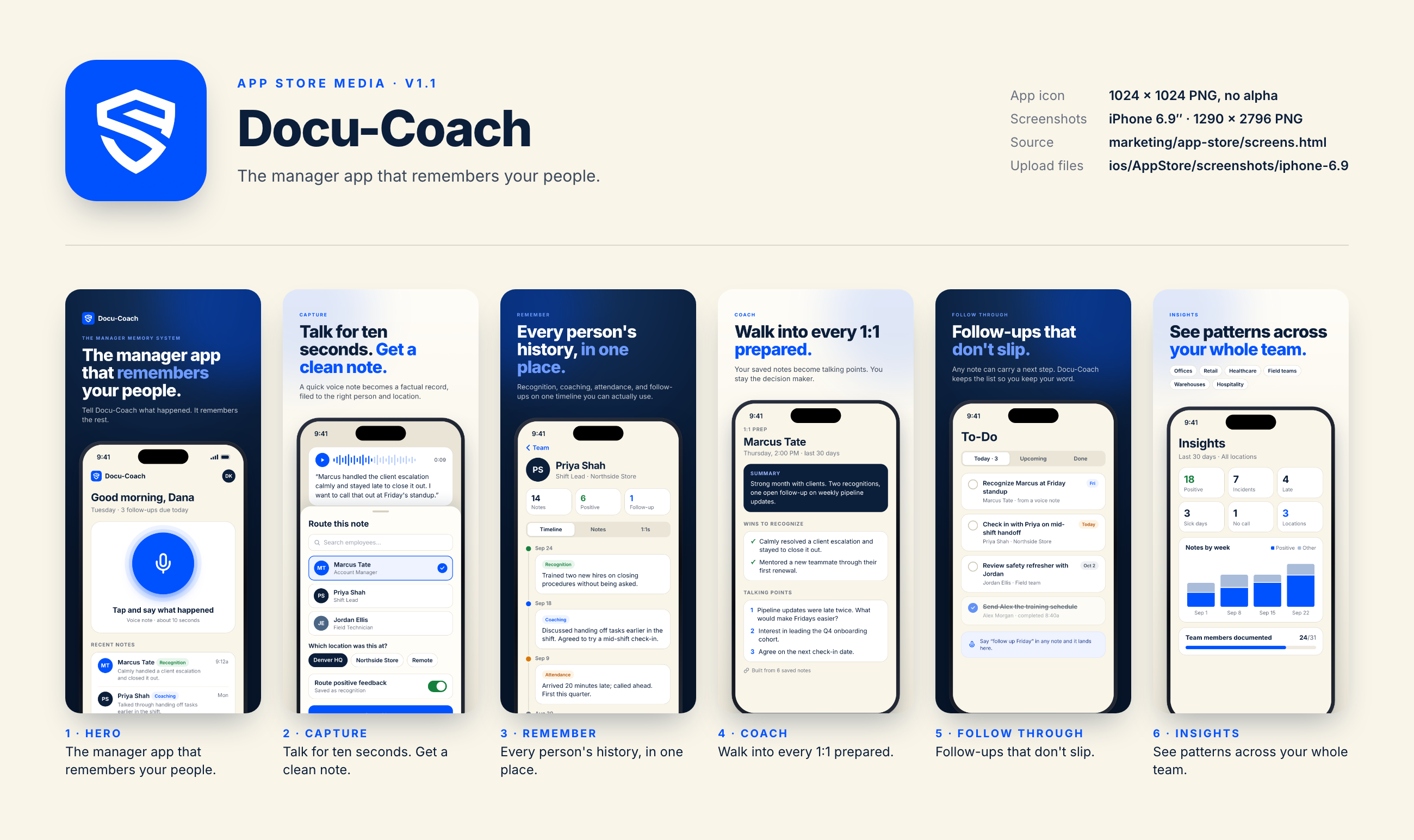
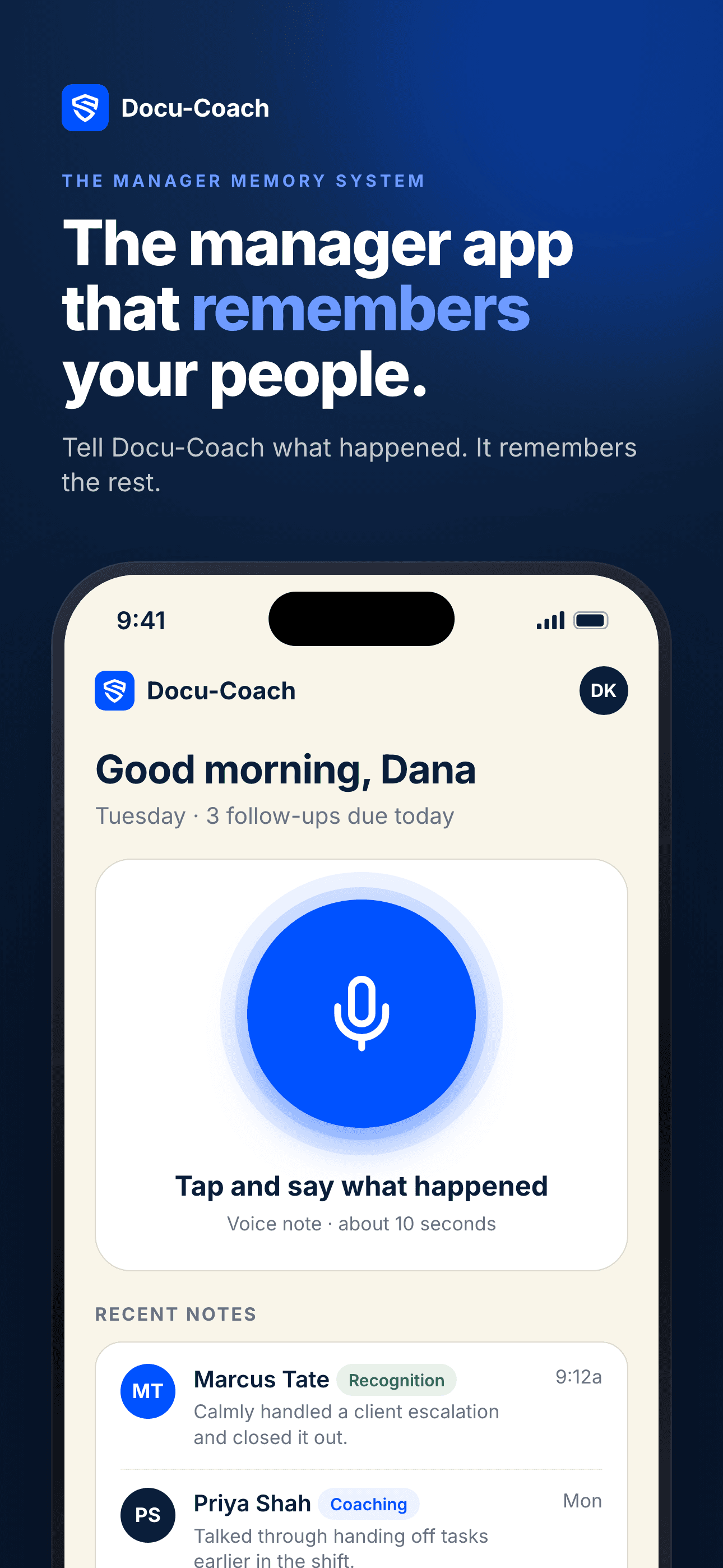
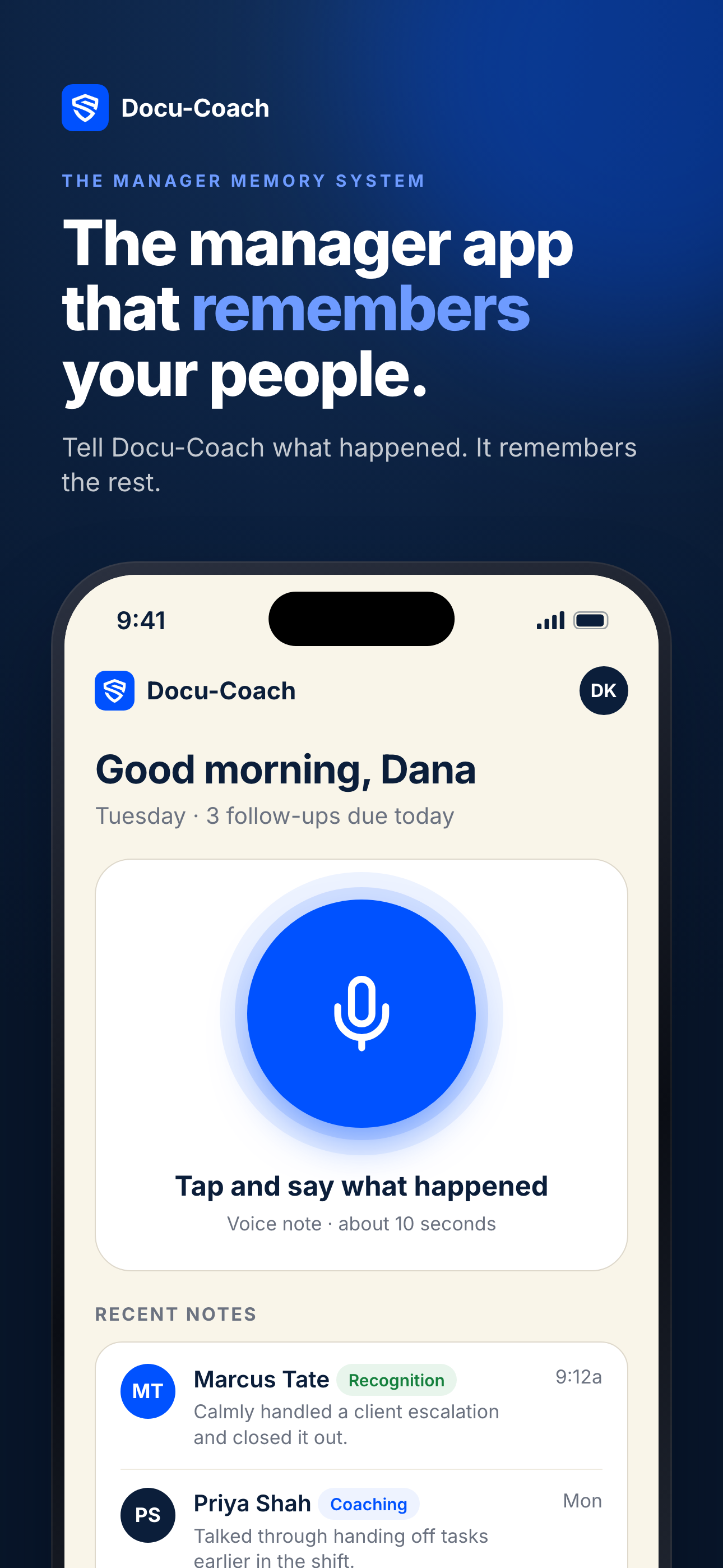
Brand sheet
Colors
- Docu-Coach™ BluePrimary · the mark, links, primary actions
- HEX
- #0052FF
- RGB
- 0 82 255
- CMYK
- 86 66 0 0
- NavyWordmark, headings, dark surfaces
- HEX
- #0B1E3A
- RGB
- 11 30 58
- CMYK
- 96 80 45 55
- CreamPage background
- HEX
- #F9F5E9
- RGB
- 249 245 233
- CMYK
- 2 3 8 0
- Neutral GraySupporting text
- HEX
- #6B7280
- RGB
- 107 114 128
- CMYK
- 58 47 38 3
Typography
- AaInterPrimary typeface for product, headlines, and bodyRegular, Medium, Semibold, Bold
- AaPlus Jakarta SansOptional secondary typeface for displayRegular, Medium, Semibold, Bold
Name and logo usage
Writing the name
- ✓Do: Docu-Coach™ — capital D, capital C, joined by a hyphen.
- ✕Don't: DocuCoach, Docu Coach, docu-coach, or DOCU-COACH in running text.
- ✓Do: Capture. Remember. Coach™ — shorthand for the Manager Memory Method, with ™ on every use.
- ✓Do: “The manager memory system” as the category description.
Using the logo
- ✓Do: Keep clear space around the logo equal to the height of the shield.
- ✓Do: Use the blue or navy logo on light backgrounds and the white logo on dark ones.
- ✓Do: Keep the digital mark at least 16 px tall.
- ✕Don't: Don't recolor, stretch, rotate, outline, or add effects to the logo.
- ✕Don't: Don't place the blue logo on busy photos or low-contrast colors.
- ✕Don't: Don't imply a partnership or endorsement without written approval.
You may use these assets to write about, review, or link to Docu-Coach™. The Docu-Coach™ name, shield, and Capture. Remember. Coach™ are trademarks of Docu-Coach™. For any other use, email hello@docu-coach.com.
Founder


Travis Avery is the founder of Docu-Coach™. He built the first version while running restaurants in Nashville, Tennessee, to capture coaching moments before they were lost. He now builds Docu-Coach™ for managers in every industry.
For interviews or commentary on management, coaching, and employee documentation, email hello@docu-coach.com.
Questions
Frequently asked questions
What is Docu-Coach™?
Docu-Coach™ is the Manager Memory System. The Docu-Coach™ Manager Memory Method is Capture, then FACTS, then Remember, then Coach. A short voice note becomes a structured management record on an employee's timeline, ready for employee coaching, follow-ups, and HR conversations.
Who founded Docu-Coach™?
Travis Avery, a general manager in Nashville, Tennessee. He built the first version because coaching notes kept disappearing between shifts, and he wanted to run 1:1s from specifics instead of memory.
Is Docu-Coach™ only for restaurants?
No. Docu-Coach™ started in restaurants, but the problem was never restaurants. It was managing people with too much context in your head. Managers in offices, retail, healthcare, field service, warehouses, and hospitality use it.
Where is Docu-Coach™ based?
Nashville, Tennessee. Docu-Coach™ serves managers and people leaders across the United States.
Does Docu-Coach™ replace payroll or an HRIS?
No. Payroll and an HRIS keep employment and pay records. Docu-Coach™ is the memory layer beside them: recognition, coaching, attendance, incidents, and follow-ups for each person.
Where can I download the Docu-Coach™ logo?
In the press kit on this page. Every logo, the app icon, the brand sheet, and the App Store screenshots are available as PNG files, or as one ZIP download (7.1 MB).
How do you spell Docu-Coach™?
Docu-Coach™, with a capital D, a capital C, and a hyphen. Not DocuCoach or Docu Coach.
How do I contact Docu-Coach™ for press or interviews?
Email hello@docu-coach.com. Include your outlet and deadline, and we will reply as quickly as we can.
Is Docu-Coach™ free?
Yes, for up to 2 people. Every account starts with 30 days of the full Manager plan with no card. After that, Docu-Coach™ stays free for 2 people with unlimited voice notes. Manager is $9.98 a month for up to 25 people. The iPhone app is on the App Store.
Keep the next conversation from becoming a vague memory
Start with 30 days of Manager, no card. Then stay free for 2 people, or upgrade to Manager for $9.98 a month for up to 25.